In the opofinance.com review, we introduce a project whose creators invite traders to join 200,000 active clients and trade on financial markets with a leading modern broker. Company clients can create an account in 30 seconds, use both real and demo accounts, and execute trades on a modern trading platform. Users are even told that the broker operates under full regulatory compliance. We decided to verify how accurate these claims are and whether such bold promises might be hiding a typical scam. The results of our investigation into the platform can be found in the article below.
Quick Overview
Domain: https://opofinance.com/
Company Name: OPO FINANCE (PTY) LTD and others
Year Founded: 2021
Jurisdiction: South Africa, Australia. Seychelles, Saint Vimcent and the Grenadines
Legal Status: Licensed by FSCA No. 54594, by ASIC No. 402043, by FSC of Seychelles No. SD124
Minimum Deposit: 100 USD
Leverage: Up to 1:2000
Available Assets: Forex & CFDs
Trading Platforms: MetaTrader 4/5, cTrader, TradingView, OpoTrade
Account Types: Standard, ECN, ECN Pro, Social Trade, Prop, Black (for MT4/5); cTrader ECN, cTrader ECN Plus, cTrader Copy; Standard, ECN, ECN PRO (for OpoTrade)
Deposit/Withdrawal Methods: Bank wire/Debit/Credit cards/ePayments/Crypto
How to Register on the Website
Opofinance promised potential clients so many interesting features that we decided to register with this broker first. This allows us to assess how well the real offerings in the personal account match the appealing promises.
The registration process turned out to be fairly simple and consists of two steps:
- Fill in the form with your first and last name, email, and phone number.
- Set a password for authorization and, optionally, enter a referral code if available. Additionally, you must confirm your agreement with the Client Agreement terms.
After submitting the information, the email address must be verified (by entering a PIN or clicking the link in the confirmation email). At this point, the account creation is complete, and the new client gains full access to the personal account, web terminals, and trading applications. However, before using them, the client will be prompted to read and accept several mandatory documents.

Deposits via e-wallets, cards, and bank transfers are also supported, but customer support recommends using crypto transactions. Of course, no mention is made of the fact that such actions conflict with AML policies.
Overall, it is reassuring that all promised functions are implemented in the Opofinance personal account. The only remaining question is how the broker interacts with the Australian regulator, which, as far as we know, imposes rather strict requirements, most of which are not met on this online platform. Or perhaps the company has a separate site for clients wishing to trade under the regulator’s supervision? If so, why was this information not provided to us?
In short, the first impression is neutral: this is a typical offshore broker, equipped with licenses from various regulators. Naturally, it does not operate without violations, but so far, it seems regulators are turning a blind eye. Let’s see what else this platform will impress or disappoint us with.
Opofinance Trading Instruments and Platforms
From the standpoint of providing traders with information, the platform stands out positively compared to most brokers currently active online, including regulated ones. At least on the Trading – Markets pages, it lists all markets available to traders, provides a few details about each (though we consider this clearly insufficient), and even includes some parameters for trading certain instruments.
So, clients are offered trading in:
- Currency pairs on the retail Forex market.
- Precious metals paired with USD and EUR.
- CFDs on industrial metals, energy products, and other commodities.
- CFDs on stocks listed on various global exchanges.
- CFDs on major stock indices.
- CFDs on cryptocurrencies.
Overall, we can say that the company’s range of trading instruments could be much wider. Since it claims official registration and licensing, it should have no issues purchasing quote feeds from electronic trading systems such as Reuters. However, judging by the asset list, Opofinance appears to be economizing and sources its asset prices from third-party providers (most likely currently under an agreement with TradingView, as trading on that platform has also been offered to users).
This applies not only to traditional CFDs but also to cryptocurrency contracts. Crypto trading enthusiasts may find the platform’s offering limited: only the most well-known digital assets are available, and the choice of base assets for contracts is also small. Generating huge profits on shit coins or meme coins will not be possible here. On the other hand, the extreme risks of crypto trading on centralized and decentralized exchanges are avoided.
Where the broker has no issues is trading platforms. Today, the company offers clients a rich selection of the industry’s top terminals:
- MetaTrader 4 and MetaTrader 5, available in desktop (Windows and MacOS), mobile (iOS and Android), and web versions.
- cTrader for Windows, Android, and iOS.
- TradingView, which allows trading on this platform (presented to users as a new option, though the start date of the agreement is not indicated). The platform is available in web, desktop, and mobile versions.
It is safe to say that virtually every trader is familiar with at least one of these programs. Their strengths and weaknesses are well-known, and detailed tutorials are easily accessible directly on the official developer websites. This allows each client to choose the software best suited to their needs without discomfort.
Account Types Offered
We have already noted that Opofinance discloses trading conditions in more detail than most brokers. For example, tables on the Markets pages include average spreads as well as swaps for long and short positions. Unfortunately, not all trading instruments are included in the tables, but they provide a general overview of these parameters.
The broker offers a wide range of account types. For each trading platform, the broker provides a full set of plans.
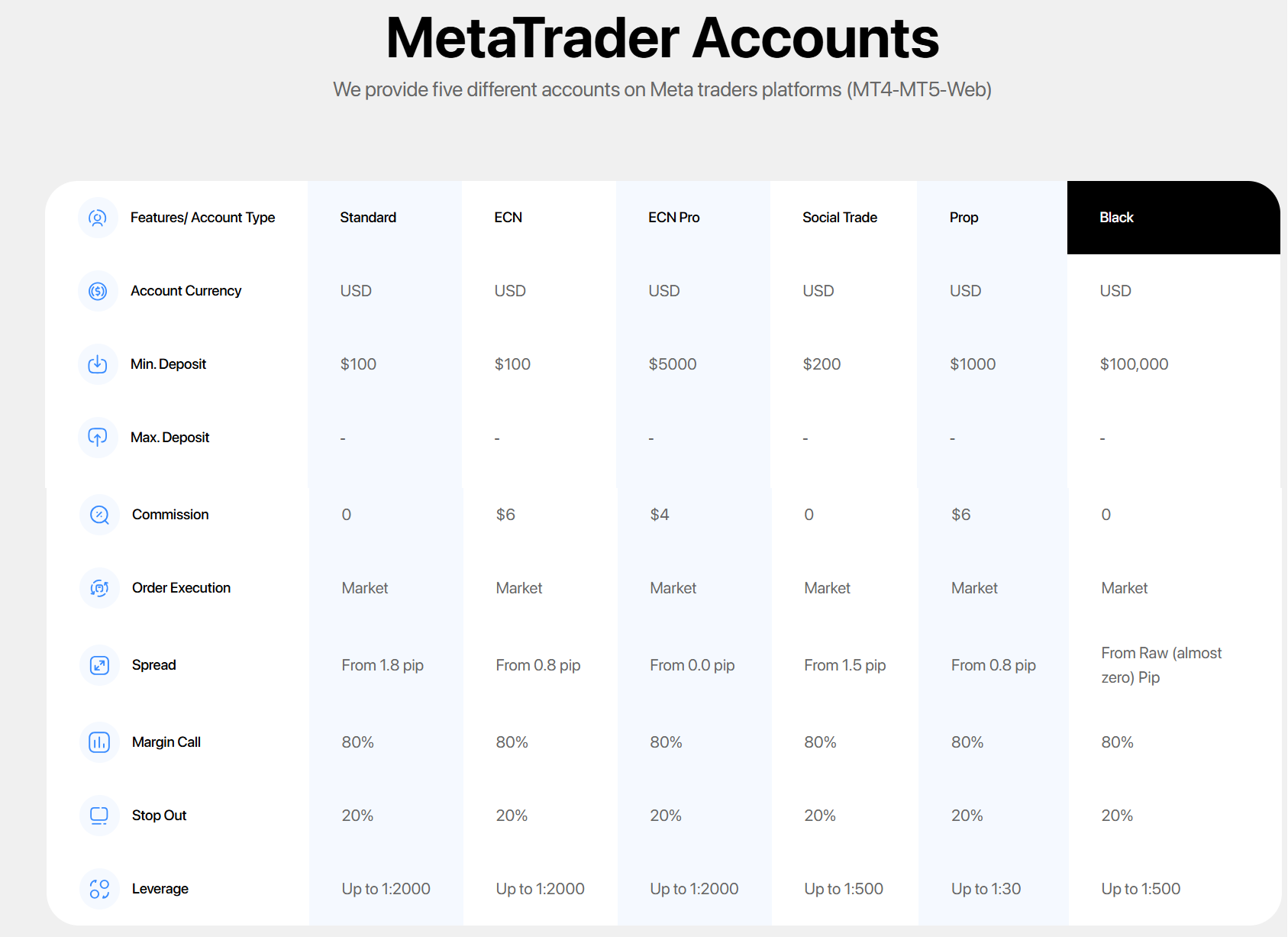
For the MetaTrader platforms, the company’s clients can choose from four account plans:
- Standard.
- ECN.
- ECN Pro.
- Black.
The first two are entry-level accounts and allow trading with a minimum deposit of $100. Trading commissions on the Standard account are not charged, while on ECN accounts they are $6 and $4 per standard lot, respectively. However, trading on ECN Pro requires an initial deposit of $5,000. Spreads on ECN Pro start from 0.0 pips, while on ECN the minimum is 0.8 pips, and on Standard it is 1.6 pips. This means trading costs are roughly twice as high as for most regulated brokers, applying to both DD and ECN accounts.
By the way, the company does not specify which ECN network is used. It may imply that the technology operates within the broker’s internal network, but 200,000 clients are unlikely to provide sufficient liquidity. The use of external liquidity providers is unconfirmed, so it is possible that the platform merely claims to use ECN technology while executing all client orders internally (or simulating execution on the terminal screens).
The most advantageous plan is Black. Traders with this account can trade with zero commissions and zero spreads. However, the minimum deposit of $100,000 is extremely high. As a result, wealthy clients do not generate trading profits for the company (except for swap or rollover fees). Is this a philanthropic broker? Such a thing does not exist. This implies that the company either profits from using client funds for its own purposes or expects to retain the entire invested amount as a profit.

For the Black account, leverage is somewhat lower — up to 1:500 — but it is still excessively high, and client risks, especially for retail traders, exceed acceptable levels.
On cTrader accounts, the situation is similar, with slightly lower leverage — maximum 1:500 on ECN and ECN Plus. Otherwise, there is almost no difference between MetaTrader and OpoTrade accounts.
In addition to accounts for self-directed trading, Opofinance offers plans for social or copy trading. Conditions largely replicate the Standard plan, except the minimum deposit is higher and leverage is lower. The choice of strategies to follow in the personal account is quite wide, including highly profitable ones (e.g., over 1000% total return). However, the risk level is also high, which somewhat distorts the very idea of social trading.
The broker also allows clients to try prop trading. The two-stage challenge conditions are strict, and clients trade with their own funds. Only after completing both stages do they gain access to financing. According to the official website, the funding amounts are not astronomical — $10k, $75k, or $200k.
Deposits and Withdrawals
We have already discussed the methods of handling financial transactions when describing the Opofinance personal account. To recap, funds can be deposited via bank transfer, credit/debit cards, ePayments systems, or cryptocurrency wallets.
On the Deposit/Withdraw page of the website, there is a table listing the available payment methods and the conditions for executing transactions, including minimum and maximum transfer amounts, fees, and processing times. In principle, we did not see anything unusual in these figures, except for fees on credit card transactions. For these operations, the company charges 2.5% of the amount, with a minimum of $1, in addition to all payment system fees being paid by the user. It seems the broker may be attempting to pass its own card processing costs onto the client.
Another issue to note is that cryptocurrency deposits inherently conflict with the AML policies of any regulator. In such operations, both the sender and recipient remain anonymous, and the source of funds is unknown. To prevent this, many regulators, particularly in Europe, require authorization for VASP/CASP (Virtual Assets Service Provider / Crypto Assets Service Provider) and de-anonymization of transactions. However, no mention of such authorization is made by this broker, and the AML Policy is entirely absent from the documents.
Opofinance Legal Status: Legitimate or Not?
We have mentioned more than once that the broker claims official registration and multiple licenses. These statements are based on information provided on the official website, but all such data requires verification.
The project creators claim that Opofinance is represented by several companies:
- OPO FINANCE (PTY) LTD, registered in South Africa, holding license FSCA № 54594. This entity is displayed on the main banner of the homepage.
- OPO FINANCE PTY LTD, registered in Australia, operating under AFSL № 402043 from ASIC.
- OPO GROUP LTD, registration number 8430865-1 (Seychelles), holding Securities Dealer license № SD124 from the FSA of Seychelles.
- OPO GROUP LLC, registered in Saint Vincent and the Grenadines under № 866LLC2021.
As we can see, the project is allegedly regulated by several authorities, some highly reputable (ASIC) and others offshore. We began by investigating the South African company.
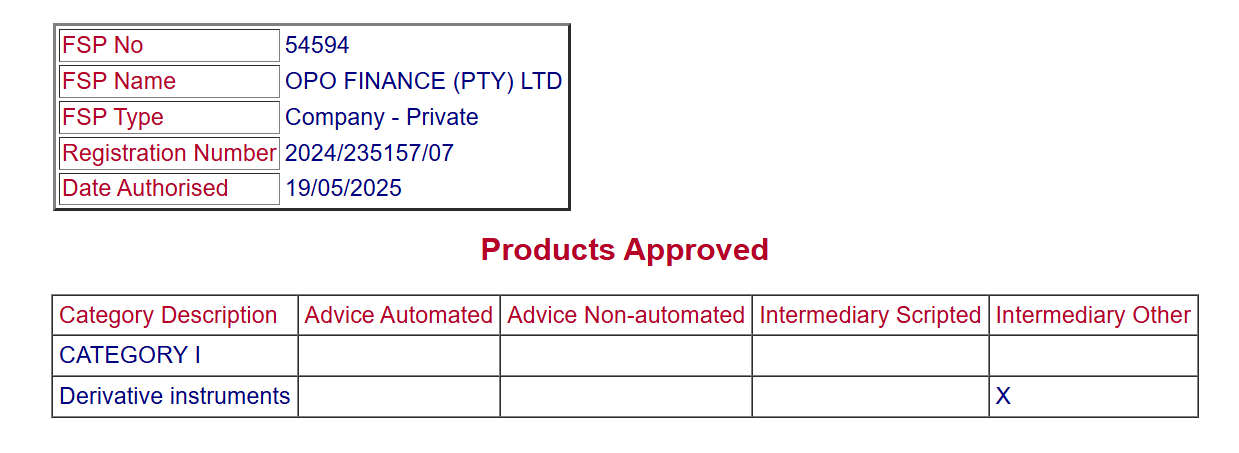
As we can see, the South African regulator has indeed authorized OPO FINANCE (PTY) LTD as an FSP (Financial Service Provider) under № 54594. The license was issued on May 19, 2025, for intermediary services (meaning brokerage) dealing exclusively with derivatives — and CFDs fall into this category. It is possible that the platform genuinely operates under this document.
It was not difficult to find information about the Australian company OPO FINANCE PTY LTD. It was registered under ACN 050 569 250 in 1991. The company has held an Australian Financial Services License (AFSL) № 402043 since 2011, authorizing it to act as an advisor regarding derivatives and Forex for retail and wholesale clients.
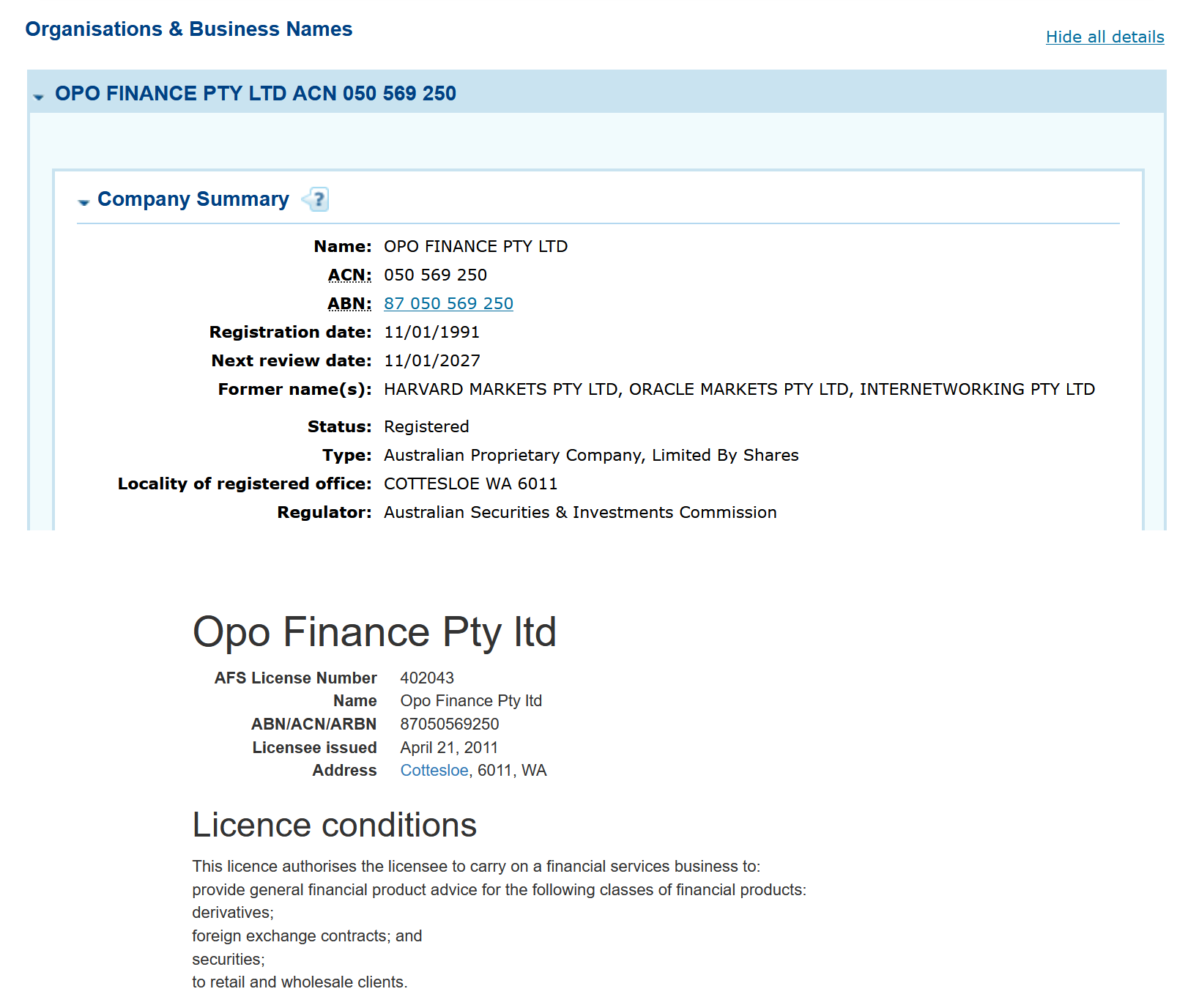
As we can see, the Australian license does not authorize brokerage activity. This explains why it is not shown as the main license on the website and was likely added simply to enhance the platform’s image.
In the FSA of Seychelles’ regulated entities list, under Securities Dealers, there is a record for OPO GROUP LTD. Its trading name is not listed, but one of its websites is https://opofinance.com/.
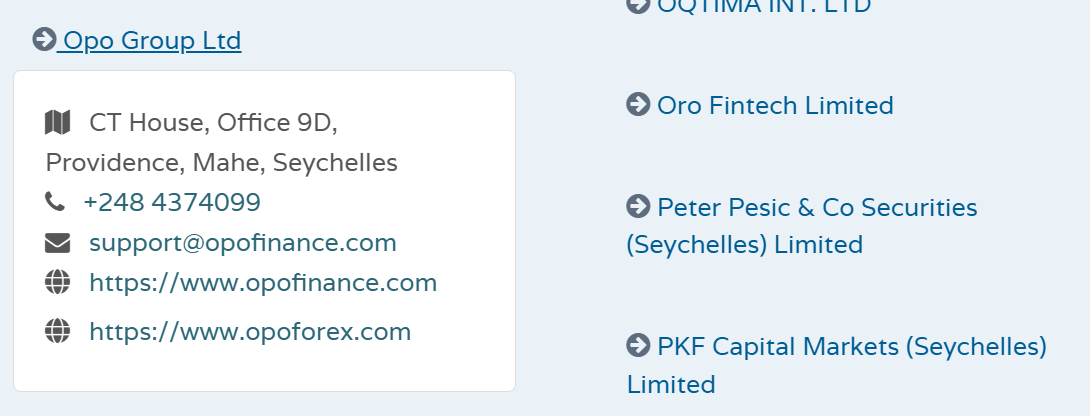
Thus, the first and only confirmed regulatory document related to the project is the Seychelles license. Although Seychelles is an offshore jurisdiction, this license is well-known and respected in the industry. Many regulated brokers operate under similar licenses.
Information about the company registered in Saint Vincent and the Grenadines was also confirmed. Of course, it does not have a license, as the local regulator SVGFSA neither registers nor licenses brokerage activity. Interestingly, the documents on the website that govern the relationship between the broker and the trader are issued in the name of this company.
So which legal entity are the platform’s clients actually dealing with? We do not have a precise answer. Therefore, we cannot say whether Opofinance’s activities are truly regulated, in which countries the broker operates legally, or what level of protection registered users can expect.
Company History
Opofinance has not disclosed its history on the official website. We can only judge it based on official documents and information from other sources.
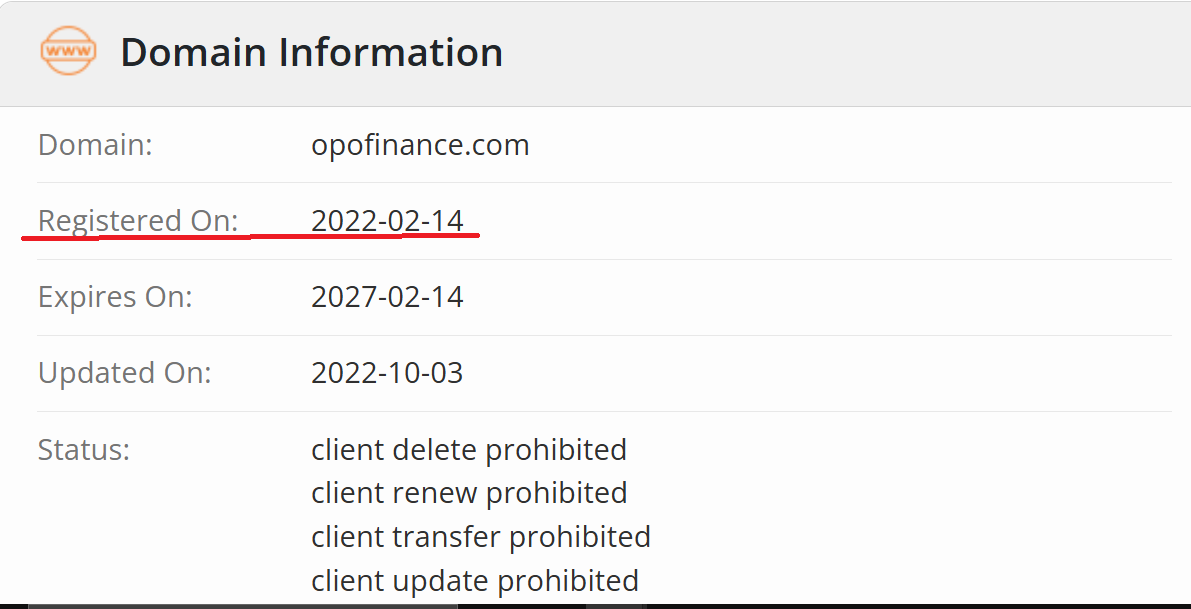
We see that the domain opofinance.com was created in February 2022. However, the Australian company referenced by the broker was registered back in 1991 and received its license in 2011. Still, it is not involved in brokerage activities, so we do not consider its data relevant.
The other companies, however, were registered between 2021 (the firm from Saint Vincent and the Grenadines). In February 2021, the domain opoforex.com (also owned by the broker) was registered. Therefore, we can say that the platform likely began operating in 2021. This is somewhat confirmed by social media profiles, most of which were created in 2021–2022. Yet, the South African company license was issued only in 2025. Does that mean the broker was providing services illegally before that?
Opofinance.com Online Reputation
The online feedback presents an interesting picture. There are 93 comments on Trustpilot, with the first Opofinance review dated January 4, 2024. Why was nothing said for almost three years? Perhaps the broker only started trying to improve its reputation from that point. This is suggested by the fact that 83% of the posts are positive.
The picture is somewhat different on specialized portals. Here, ratings are not very high, barely reaching a neutral level. For example, on WikiFX, Opofinance received 4.74 out of 10, and out of 14 user comments, 8 are negative. Clients accuse the broker of unfair trades and withdrawal problems. The portal administration even posted a warning advising traders to exercise caution.
Pros and Cons
-
Various trading terminals.
-
Verified license.
-
Offshore legal entities.
-
Extremely high leverage.
-
Use of cryptocurrency for payments.
-
Mediocre online rating.
The Final Take
The confirmed official registrations and active licenses do not allow us to categorically call Opofinance a scam. However, working with an offshore regulator allows the broker to manipulate trading conditions freely, offering traders leverage of up to 1:2000. The time lag between the platform’s launch and obtaining a license, along with clearly fabricated positive reviews, is concerning. It gives the impression that the company often employs illegal methods of interacting with clients. We would advise avoiding trading on this platform.


I feel that the scammers at Opofinance manually manipulate the quotes so that we go bankrupt faster and deposit even more money. I started with $5,000, but within a few days I was left with only a third of that amount. No profit at all — only losses. Is there any point in trading under conditions that benefit only the scam project? This setup cannot even really be called a broker; it’s just a trading simulator that you pay with real money.