Today, we present a cifmarkets.com review, examining a broker that promises clear explanations, smart risk controls, and simple dashboards that grow with your skills. However, such claims require verification, so we’ll examine the company’s offerings in detail to determine whether it’s truly trustworthy or just another dubious project.
Quick Overview
- Domain: https://www.cifmarkets.com/
- Company Name: ACLIVE WEALTH ADVISORY (PTY) LTD
- Year Founded: 2026
- Jurisdiction: South Africa
- Legal Status: Licensed by FSCA
- Minimum Deposit: $250
- Leverage: 1:200
- Available Assets: CFDs
- Trading Platforms: WebTrader
- Account Types: Silver, Gold, Platinum
- Deposit/Withdrawal Methods: Bank cards, PayPal, Skrill, Neteller, AstroPay
How to Register on the Website
Registering on the broker’s website seems simple at first glance. A standard registration form opens, requiring you to enter your email address, contact number, full name, and create a password. At this point, the process may seem completely standard and straightforward.
However, don’t jump to conclusions. In fact, your registration may simply not complete. We encountered exactly this. After filling out the form, we were still unable to access the platform because, for some reason, our region was not accepted.
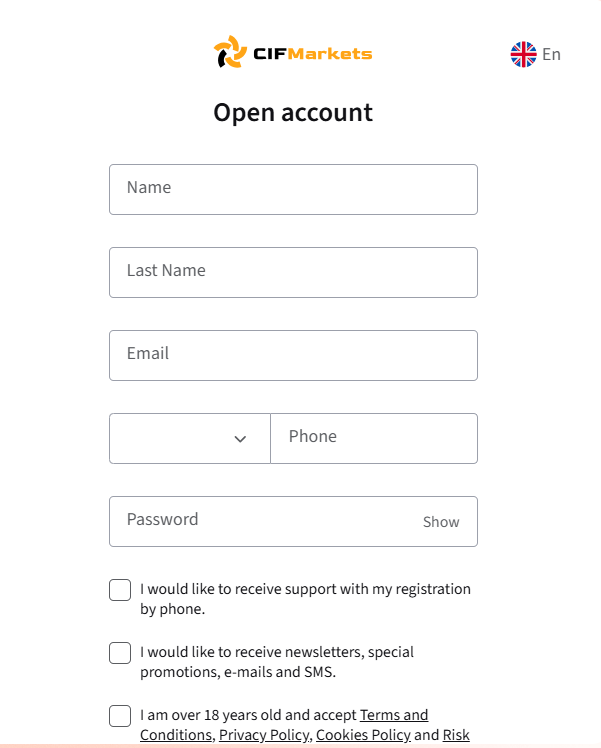
Apparently, a significant number of regions are restricted from registration. However, the broker doesn’t publish a full list of countries whose residents are unable to use its services.

CIFMarkets Trading Instruments and Platforms
The trading instruments section on CIFMarkets looks fairly standard for a CFD broker and covers the main asset categories: forex, metals, cryptocurrencies, stocks, commodities, and indices. Moreover, all offerings are limited exclusively to CFDs, meaning trading on price differences rather than actual asset ownership.
In the Forex market, users are offered major, minor, and cross-currency pairs, with claims of transparent pricing and built-in risk management tools. The metals section features gold, silver, and platinum, traditionally used as safe havens, but again, these are only available in CFD format.
Cryptocurrencies are highlighted separately, claiming access to leading digital assets with the ability to analyze volatility. A similar approach is applied to stocks. Among the available instruments, major international companies are mentioned, including Apple, Microsoft, Nvidia, and Tesla, but also exclusively in CFD format. Commodities and indices complete the toolkit, providing access to oil, gas, agricultural commodities, as well as major global indices such as the S&P 500, NASDAQ 100, Dow Jones, and European indices.

Account Types Offered
CIFMarkets’ trading account section follows the classic CFD brokerage model and includes three main levels: Silver, Gold, and Platinum.
- The basic Silver account is positioned as a good starting point for beginners. It offers standard conditions: leverage up to 1:200, a minimum lot size of 0.01, and that’s it. Essentially, it’s a bare minimum feature set without any advantages.
- The Gold account supposedly expands user capabilities through partial discounts on trading costs, namely 40% on swaps and 50% on spreads relative to the basic level. However, the key trading parameters — leverage and stop-out level — remain unchanged.
- A similar situation is observed on the Platinum account, where discounts increase, but the basic terms and conditions remain unchanged.
Despite all the differences between accounts, critical trading parameters remain fixed. It’s unclear to us why this account gradation is necessary at all, when the main difference lies not in functionality but in the level of supposed privileges, which in reality have little impact on trading quality.
Deposits and Withdrawals
CIFMarkets’ deposit and withdrawal section is quite surprising, not least because there’s only one small section for deposits and several pages for withdrawals.
Account funding is only possible after verification. The list of available systems is quite extensive: bank transfers, SWIFT, cards, e-wallets, and other electronic payment methods. However, the company reserves the right to charge an additional commission of up to 3% + a fixed amount for each deposit.
It’s also worth noting that the broker reserves the right to request detailed documentation from clients regarding the origin of funds. This includes bank statements, card details, SWIFT/SEPA confirmations, and additional proof of ownership of payment instruments.
The withdrawal process is also described as multi-step and strictly controlled. Before processing the request, the company verifies the client’s details, the availability of all KYC documents, the available balance, and compliance with internal rules. It is also noted that the client may incur fees and conversion costs, which are paid separately. Withdrawal processing times are officially stated as 1-3 business days, but actual receipt of funds can take up to 5-7 business days depending on the bank and payment method. The broker expressly disclaims any liability for any delays caused by banks or payment systems.
CIFMarkets Legal Status: Legitimate or Not?
The broker claims to provide services on behalf of a legal entity, ACLIVE WEALTH ADVISORY (PTY) LTD, registered in South Africa. The company also claims to be licensed by the FSCA. We’ve verified this, and this is indeed confirmed. The organization is licensed.
However, the key question here, in our opinion, lies in the specific powers and level of protection they provide to clients. South Africa and the FSCA are considered mid-level regulated jurisdictions, and their requirements are significantly more lenient compared to regulators such as the FCA.
Company History
An interesting point is that, according to publicly available data, the company was registered in South Africa in 2022. However, this doesn’t necessarily mean it was founded then. First of all, active mentions and reviews of the broker only began appearing in large numbers relatively recently. For a company with a supposed history of several years, this seems odd. Therefore, we additionally checked the website’s domain name and found that it was registered only on April 2, 2025.
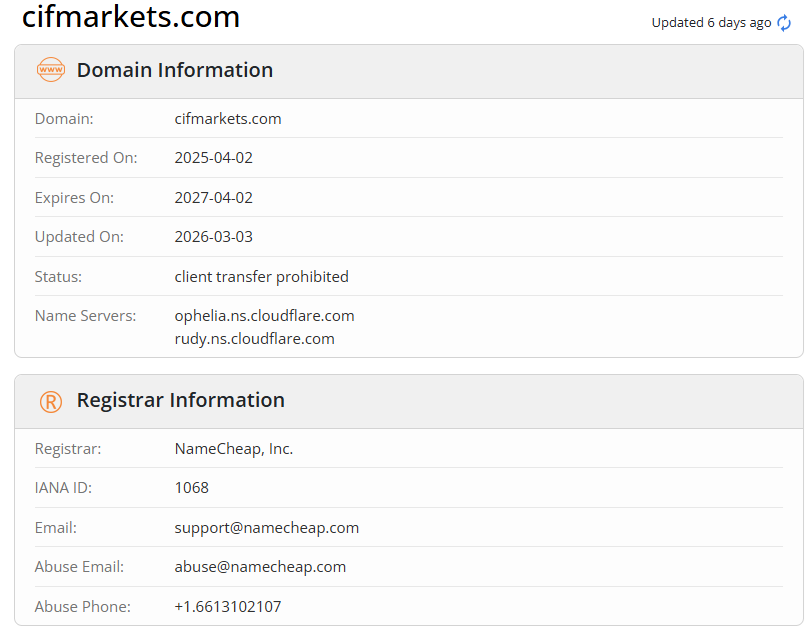
This means that, by all indications, the project’s actual online presence began significantly later than the company’s stated founding date. Therefore, the project’s actual online activity has been going on for a very short time. This is a relatively new broker that recently entered the market.
Cifmarkets.com Online Reputation
The situation with reviews of the broker deserves special attention. There are very few of them in open sources, with virtually no mentions. This volume of feedback, of course, further confirms that the project has been operating for a relatively short time and has not yet established a reputation.
Pros and Cons
-
FSCA license in South Africa.
-
Wide range of trading instruments (CFDs on Forex, stocks, indices, commodities, cryptocurrencies).
-
Very short domain activity.
-
Very few cifmarkets.com reviews.
-
Withdrawal times depend on numerous conditions and can take up to 5-7 business days or more.
-
Additional fees for deposits and conversions may apply, which are not always obvious in advance.
-
Strict document requirements and source of funds verification (AML/KYC) may complicate transactions.
-
Demo access and certain platform features are not available to everyone before registration.
The Final Take
CIFMarkets, by any measure, is a licensed platform registered in South Africa. But that’s where the main advantages end. The commission structure, the complexity of withdrawal procedures, and the overall level of control over client funds, which shifts a significant portion of the risk to the user, are very concerning. Taken together, this prevents the broker from being considered a completely reliable and unambiguously safe option for trading without increased risk. So, before sending money here, please consider all the risks.


As an experienced trader, I believe it’s important to immediately outline the risks of working with them. First, the company is based in an offshore jurisdiction. While they formally have a legal entity, it’s essentially an offshore registration, where clients won’t physically travel or go to court if they encounter problems. Such jurisdictions have long been favored by entities that don’t need strict oversight. Second, they lack serious regulation. Essentially, the company operates without strict oversight, meaning the level of legal protection for clients is minimal. Third, claims of high-quality execution raise questions. You can say anything you want about ECNs, but an offshore company without strong licenses is unlikely to process trades using the A-Book model. It’s far more logical to assume there’s some kind of backroom operation, where the broker is playing against the client. Therefore, I would be skeptical of claims of flawless execution.