Today, we are taking a look at another Forex/CFD project that encourages users to make a change and start building their future today. To help traders achieve this goal, the company promises attractive trading conditions, including spreads from 0 pips, access to the popular MetaTrader 5 platform, and a wide range of copy trading strategies designed to simplify the start of a trading journey. At the same time, the broker presents itself as a reliable company that can be trusted thanks to its official registration. On the surface, the offer looks appealing. However, hundreds of scam platforms make similar promises — and often claim even more impressive benefits. Could this be one of them? You’ll find out in our solantis.pro review.
Quick Overview
Domain: https://solantis.pro/
Company Name: Solantis LTD
Year Founded: 2025
Jurisdiction: Saint Lucia
Legal Status: No license
Minimum Deposit: Unspecified
Leverage: Up to 1:500
Available Assets: Forex, CFDs on metals and crypto
Trading Platforms: MetaTrader 5
Account Types: Pro, Pro Cent
Deposit/Withdrawal Methods: Debit/Credit cards, bank wire transfers, crypto
How to Register on the Website
We actually liked the design of Solantis’ official website. The color scheme is tasteful, there are no major issues with the typography (apart from the footer), and the site avoids excessive animations and distracting graphics. Unfortunately, the amount of useful information available on its pages is just as minimal, which ultimately undermines the overall impression.
That said, we will leave those concerns to the web developers and focus instead on the registration process and the client area. Surprisingly, the registration form offered to prospective clients uses an approach that is rarely seen today. It requests almost the entire set of personal information typically associated with KYC procedures, including:
- First and last name.
- Email address and phone number.
- Date of birth.
- Full residential address.
In addition, users are asked to:
- Select a trading platform (although no real choice is provided, as MetaTrader 5 is the only available option).
- Choose an account currency, with USD, EUR, and US Cents available.
- Select an account type: PRO Trader or PRO Follower. Judging by the description, the latter is intended for copy trading.
- Create and confirm a password for account access.

Did you also feel that something was missing? If so, you’re absolutely right.
- Users are not asked to read or accept any legal documents, including basic ones such as the Terms of Use, Privacy Policy, or Risk Disclosure. In practice, this means that no formal client agreement is accepted during registration. As a result, it remains unclear under which contractual framework the broker provides services and accepts customer funds.
- The verification email states that users must complete identity verification by submitting copies of their documents. However, even without completing this process, newly registered clients can fund their accounts and start trading immediately. The only unavailable function is the ability to submit withdrawal requests. Such an approach may indicate either the absence of meaningful regulatory oversight or operation under an offshore regulator with relatively lenient KYC and AML requirements.
It is also worth noting that the Solantis client area does not offer two-factor authentication (2FA). While this feature is not mandatory, many traders consider its absence a weakness from a security standpoint.
Overall, the project makes a reasonably positive first impression at this stage. Nevertheless, several shortcomings remain unresolved. It is difficult to understand why the company has not addressed them yet, and the apparent lack of urgency in doing so raises certain concerns.
Solantis Trading Instruments and Platforms
At the next stage of our review, we expected to see a detailed list of available markets and trading instruments, examine contract specifications, and evaluate the trading platform itself. However, after the relatively positive impression left by the registration process and client area, this section proved disappointing.
The only page that provides any information about the available markets is the “Trading Solutions” section under the Trading menu. Here, the company informs prospective clients that they can trade assets from three categories:
- Forex.
- Metals.
- Cryptocurrencies.
The Solantis team also chose not to publish a complete list of available trading instruments. Likewise, contract specifications are nowhere to be found. After reviewing the limited information available, we can reasonably conclude that our earlier assumptions regarding either extremely lenient regulation or a complete lack of meaningful oversight may be justified. Well-established regulators such as BaFin, Financial Conduct Authority, and Australian Securities and Investments Commission generally require brokers to disclose detailed trading conditions and contract parameters for all offered instruments. Solantis does not appear to meet this level of transparency.
On the other hand, the broker promotes its trading platform with considerable enthusiasm. One could easily get the impression that the software was developed in-house. In reality, clients are offered access to MetaTrader 5, available in desktop, mobile, and web versions. There is certainly a reason why the company highlights this platform, as MT5 remains one of the most widely used and respected trading terminals in the industry. However, we see little reason to repeat the extensive list of advantages and disadvantages that are already familiar to most traders.
One fact is worth mentioning: the company does appear to have an official business registration. Without it, obtaining a licensing agreement from MetaQuotes and offering a fully functional MT5 platform would have been extremely difficult.
Account Types Offered
As noted above, Solantis does not provide contract specifications either on its website or within the trading platform itself. As a result, the characteristics of the available account types remain the primary source of information regarding the broker’s trading conditions for prospective clients.

During registration, we saw that users are initially offered two account types: PRO Trader and PRO Follower. Judging by their names, only the former is intended for independent trading. However, the company apparently decided that offering identical conditions to all clients would be too ordinary. As a result, two trading accounts are available: PRO and PRO Cent.
According to the account comparison table, the differences between them are minimal. The broker states that the US Cent account is designed for testing trading strategies and Expert Advisors, as well as for making a gradual transition from demo trading to live trading with real funds. Therefore, the only meaningful distinction between PRO Cent and PRO accounts is the size of the standard contract: 1,000 units of the base asset on the former and 100,000 units on the latter. All other parameters remain identical:
- Maximum leverage of 1:500.
- Minimum spread of 1.3 pips.
- Market Execution order processing.
- Minimum and maximum trade sizes of 0.01 and 500 standard lots, respectively.
Calling this information comprehensive would be difficult. First, the broker does not disclose the minimum deposit requirement for either account type. Second, swap rates remain undisclosed. Third, important risk-management parameters such as Margin Call and Stop Out levels are nowhere to be found.
As a result, several concerns arise:
- The broker offers extremely high leverage of 1:500 for Forex trading. Compare this to the leverage limits imposed by leading regulators, where retail traders are typically restricted to 1:30. A leverage ratio that is more than sixteen times higher significantly increases trading risks. If industry statistics suggest that 70–80% of retail traders lose money even with leverage capped at 1:30, the risk profile becomes substantially more aggressive at 1:500.
- It is virtually impossible to assess the overall cost of trading with this broker. The only disclosed trading expense is the spread. Information regarding commissions and swap charges is absent. Without this data, traders cannot accurately estimate long-term profitability or properly develop trading strategies. Moreover, even the published spreads appear less competitive than those offered by many regulated brokers, where spreads often start around 0.6–0.8 pips. At the same time, the Trading Solutions page promotes spreads from 0 pips and describes them as among the tightest in the industry.
- Key information required for effective risk management is also missing. Traders are not informed about minimum stop distances, order placement restrictions, or the Stop Out level. These are fundamental trading conditions that many brokers disclose openly.

Overall, while the broker appears to have an official business registration, its approach to transparency differs noticeably from that of many well-regulated brokers. Limited disclosure of trading conditions, unusually high leverage, and the lack of important account information make it difficult for traders to fully assess the risks and costs associated with the platform. In our view, these factors may indicate a relatively low level of regulatory oversight and should be carefully considered before opening an account.
Deposits and Withdrawals
It appears that Solantis’ content managers prefer to keep website pages light on information. For example, the Deposit and Withdrawals page under the Trading menu informs visitors that the broker supports various payment methods, offers deposits with fees starting from 0, and processes withdrawals very quickly. Unfortunately, that is essentially the extent of the information provided.
The page also displays numerous payment system logos, seemingly suggesting that clients can use these services directly. However, after examining the client area, it becomes clear that these logos serve more of a decorative purpose than an informational one.
The company appears to accept only Bitcoin payments and bank transfers directly. It even publishes banking details for institutions located in Zurich and Saint Lucia. However, several issues immediately stand out:
- Neither of the entities presented as banks is actually a traditional banking institution. Both are financial companies that facilitate money transfers as intermediaries. While they are legally registered and regulated, the payment details provided are not standard bank account details.
- In the case of the Swiss payment details, the beneficiary is listed as Circle Square Capital Management AG. This raises questions because the company operating the platform is presented under a different name on the official website.
Even within the client area, no additional information is provided regarding payment fees or processing times. We are also left wondering why the company chooses not to process payments directly and instead relies heavily on intermediaries. Another unanswered question concerns how cryptocurrency transfers fit into the broker’s AML compliance framework. Unfortunately, obtaining clarification may be difficult, as Solantis does not appear to publish an Anti-Money Laundering policy.
Solantis Legal Status: Legitimate or Not?
Based on the information available, we can confidently state two things:
- The broker is operated by a legally registered company.
- The broker appears to operate without a financial license and without supervision from a recognized regulator.
To verify these conclusions, we examined the official information published on the broker’s website, beginning with its corporate registration details.
In the website footer and on several other pages, Solantis states that it operates under Solantis LTD, a company registered in Saint Lucia. The broker even provides a registration number, making it relatively easy to locate the relevant information in the local corporate registry.
The registry records confirm that the company exists and was incorporated under the stated registration number on October 28, 2025. Therefore, the claim that the platform operates through a legally registered company appears to be accurate.

At the same time, registration in Saint Lucia as an International Business Company (IBC) may also serve as evidence that the broker operates outside the scope of traditional financial regulation. Companies of this type that provide services primarily outside Saint Lucia and the Caribbean region are generally not required to obtain licenses from local regulators such as the Financial Services Regulatory Authority (FSRA) or the Eastern Caribbean Central Bank (ECCB). They are also subject to fewer requirements regarding physical presence, capital adequacy, staffing, and operational standards.
Operating without a financial license also means that the relationship between the broker and its clients is governed almost entirely by the broker’s own internal documents, such as its Client Agreement. In such cases, there are typically no regulatory restrictions on trading conditions, no mandatory segregation of client funds, and no requirements for investor-protection measures such as deposit insurance or compensation schemes.
Many of the concerns discussed earlier begin to make more sense in this context. The company is not obligated to impose leverage restrictions, implement specific client-protection mechanisms, or provide trading conditions that meet the standards commonly associated with heavily regulated brokers. As a result, traders using Solantis may have limited external protections in the event of disputes or operational issues.
Company History
Solantis also makes little effort to share details about its corporate history. The reason is fairly obvious: as we have already seen, the company was incorporated only in October 2025, meaning it has been operating for roughly six months. That is hardly a remarkable track record, especially considering that the fir,m describes itself as a “trusted broker.” In reality, building such a reputation typically requires years of consistent operation.
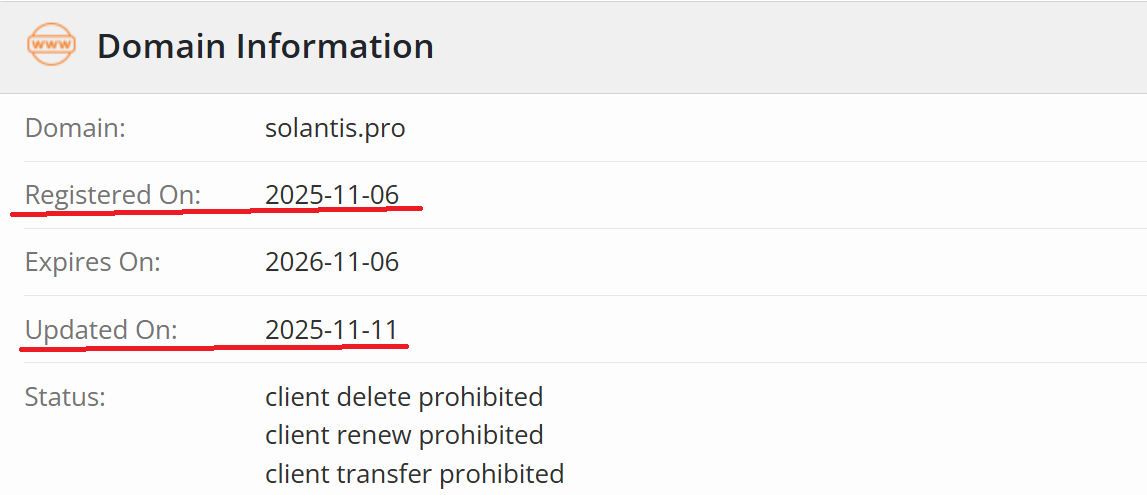
Interestingly, this is one of the rare cases where the domain history closely matches the broker’s official corporate timeline. According to WHOIS records, the domain solantis.pro was registered on November 6, 2025, and the broker’s website was launched on November 11. These dates align closely with the company’s registration records and further confirm that the platform has been active online for only a little over six months.
Solantis.pro Online Reputation
Given the project’s relatively short lifespan, we initially assumed that Solantis would have a limited online presence. However, our research suggested otherwise.
In just over six months, the broker has accumulated a noticeable number of online reviews. For example, there are 69 reviews on Trustpilot, with the first one appearing on April 12, 2026. This means that all of these reviews were posted within a period of approximately two months, averaging around nine new reviews per week.
Of course, there is nothing unusual about a company attempting to build a positive public image. However, many traders prefer to rely on transparent business practices and verifiable customer experiences when assessing a broker’s reputation.
Pros & Cons
-
Official registration in Saint Lucia.
-
Well-designed and visually appealing website.
-
No financial license, including the absence of offshore regulatory oversight.
-
Incomplete disclosure of trading conditions.
-
Extremely high leverage that significantly increases trading risks.
-
Limited transparency regarding deposits and withdrawals.
-
Questions surrounding the authenticity of some positive online reviews.
Final Take
Throughout this Solantis review, we highlighted several factors that potential clients should carefully consider before opening an account. These include the lack of financial regulation, limited transparency regarding payment operations, and incomplete disclosure of trading conditions. Particular attention should be paid to the broker’s leverage of up to 1:500, which substantially increases risk exposure and can lead to rapid losses. Combined with the absence of detailed information about fees, account parameters, and investor protections, these issues make it difficult to fully evaluate the broker’s offering. Based on the available information, we believe traders should exercise caution and conduct thorough due diligence before depositing funds with this company.


Solantis profits at the expense of inexperienced traders! They promise favorable conditions and claim that trading is virtually risk-free, but according to my experience, things changed once a larger amount was deposited. At first, the company’s analyst helped me make profitable trades. Believing that the results would continue, I invested more money and ultimately lost everything. I ended up losing $5,000!! Do not send money to this company.