Today, we take a closer look at capplace.com, a regulated Forex/CFD broker offering clients a wide range of trading assets, a modern trading platform, reliable support, and full operational security. Traders can operate from anywhere in the world, trade via mobile devices, and use a demo account. The company’s offerings appear solid, but are they truly as reliable as they seem? Can its claims of holding a license be trusted, or should it be treated as a potential scam platform? We will attempt to answer these questions.
Quick Overview
Domain: https://www.capplace.com/
Company Name: Robertson Finance Inc.
Year Founded: 2023
Jurisdiction: Mwali (Moheli), Comoros Union
Legal Status: Licensed by MISA (No. T2023294)
Minimum Deposit: USD 250
Leverage: Up to 1:200
Available Assets: Forex pairs and CFDs
Trading Platforms: Webtrader
Account Types: Silver, Platinum, Gold
Deposit/Withdrawal Methods: Debit/Credit cards, Bank wire, ePayments, Crypto
How to Register on the Website
To be honest, the design of CapPlace’s official website did not impress us. It was difficult to understand the purpose of using oversized info boxes where images and headings are clearly visible, but the small explanatory text is barely readable.
The content is not particularly impressive, either. For example, on the Markets page, visitors will find a couple of trivial phrases about each available market. One may wonder why they are included at all, given their lack of informative value. Another example is the list of holidays on local markets — arguably the most essential information for traders, especially considering that the assets concerned may not even be included in the broker’s offering. Meanwhile, there is no space allocated for analytics, a news feed, or even an economic calendar. Apparently, the owners of CapPlace believe their clients can manage perfectly well without these tools.
However, the registration process left a lasting impression. Users are required to provide extensive personal data, including their taxpayer identification number (fortunately, they stopped short of requesting a full autobiography or a family tree going back 200 years). Why a broker — one that is not a tax agent in any jurisdiction and therefore not authorized to handle taxes on behalf of clients — needs such information remains unclear.
And that is not all. Be prepared to answer a dozen additional questions in a questionnaire covering your finances and trading experience. The purpose of this is also unclear. The regulator the company claims to work with does not require such detailed disclosures in any of its policies and does not even differentiate between retail and professional traders.

Even the account creation process itself is not straightforward. Since the offshore jurisdiction where the broker is registered has a questionable reputation, and its regulator’s license is barely recognized internationally (more on this below), CapPlace is forced to significantly limit the list of countries from which it accepts new client registrations. Therefore, encountering a message such as “is not available in your location or to residents of your country” after submitting the registration form did not come as a surprise.
Of course, we found a way around this issue. What remains unclear is why create such a problem in the first place — would it really be so difficult for the platform’s staff to publish a full list of countries whose citizens and residents are not eligible to open accounts? In fact, even at this stage, we observe a fairly typical pattern: the company is trying hard to appear as solid as possible and to create the impression of a serious, regulated platform. However, such efforts fall short — fraudulent projects rarely manage to convincingly resemble professional market participants.
CapPlace Trading Instruments and Platforms
We have repeatedly encountered bold claims on the website about the ability to trade across almost all major financial markets and promises of a wide selection of trading instruments. But what do we actually see in reality?
- The range of available markets is indeed sufficient to satisfy most traders. The broker offers Forex currency pairs, CFDs on indices and stocks, metals and other commodities, as well as cryptocurrencies. However, the descriptions of these asset classes can hardly be called even minimal (as mentioned earlier, the platform’s specialists limited themselves to just two sentences per category). Is such a “comprehensive” amount of information enough for users to evaluate their advantages, risks, and specifics? It is difficult to determine whether this approach stems from saving space on the website or from a lack of expertise.
- The selection of trading instruments is not as broad as advertised. The Markets page promises over 300 assets, yet the Contract Specifications document lists fewer than 280. Are the website creators unaware of the full list, or does CapPlace simply not consider it necessary to keep information up to date? In either case, this reflects a dismissive attitude toward client needs — one that likely extends to other aspects of the service.
We could not overlook the trading platform itself. The broker uses proprietary software built on a TradingView price widget. This approach allows users to benefit from the full range of analytical tools offered by this well-known platform.
The terminal developers have also implemented several interesting functional solutions. For example:
- Full contract specifications are displayed in the same window as the price chart, but in a neighboring tab.
- The overview includes not only current prices but also market sentiment — the ratio of long to short positions for each instrument.
- The order panel is designed to be convenient and informative, supporting all types of trading orders.
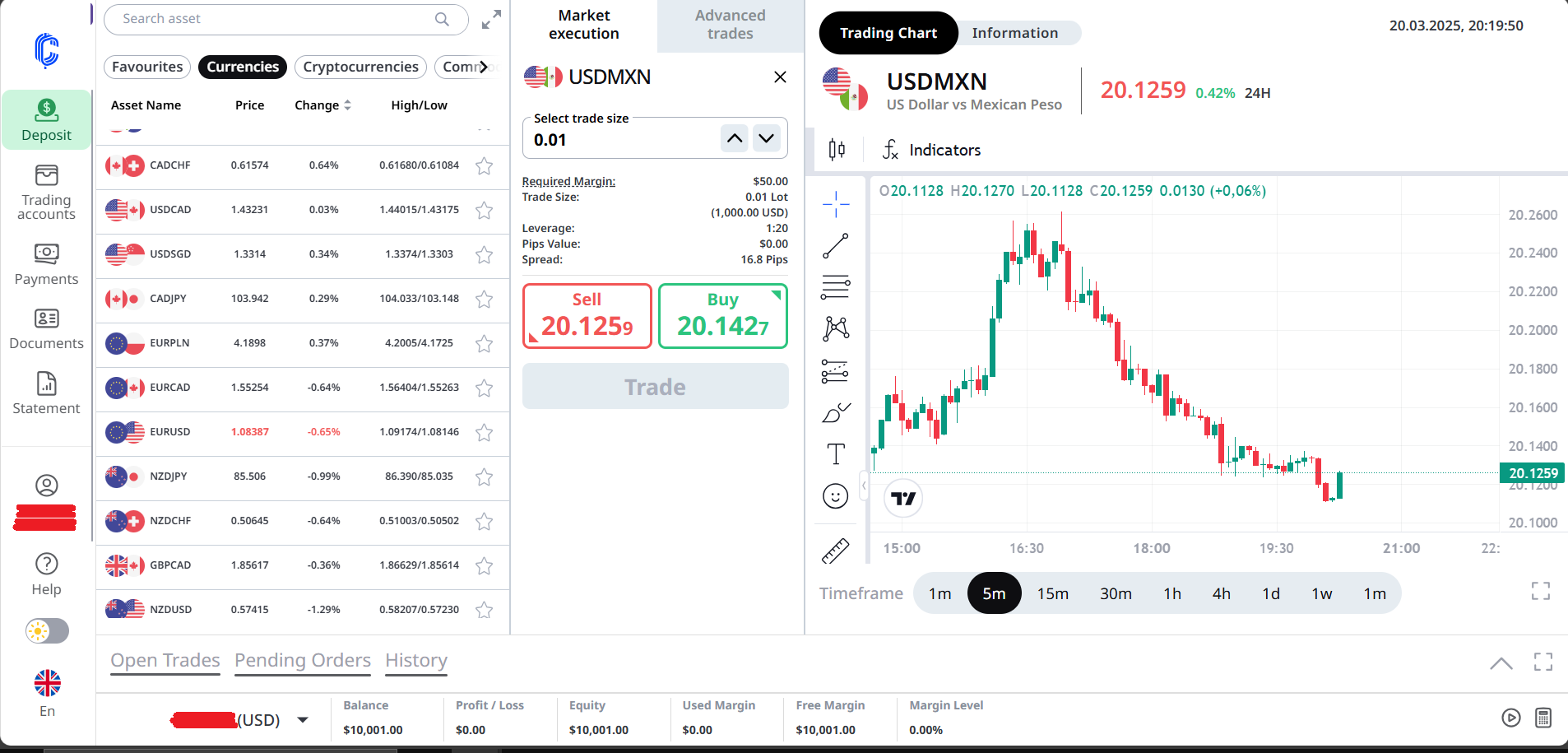
However, this trading platform also has some obvious drawbacks:
- The multi-chart mode can hardly be considered full, primarily due to the size of the price charts and their limited number within a single window (this is due to the properties of the TradingView widget). As a result, effective position management for portfolio traders, scalpers, and users of other strategies requiring high-speed order placement and processing becomes at least inconvenient, and more precisely, problematic.
- There is no one-click trading mode, although the dedicated order panel could easily support such functionality.
- Traders cannot customize the layout or arrangement of windows to suit their preferences. The only available option is limited resizing of panels, and even that within narrow constraints.
- No automation tools are provided: there is neither a built-in programming language for creating custom modules nor API support. It is also impossible to develop custom indicators or connect third-party scripts.
These are common shortcomings of trading platforms developed by lesser-known providers. What remains unclear is why a formally registered broker chose not to adopt well-established terminals, such as those from MetaQuotes or TradingView. One possible explanation is cost reduction.

Account Types Offered
The publication of trading conditions is one area where CapPlace performs better than many modern brokers. Let us begin with the Account Types page. As we can see, there are only three options: Silver, Gold, and Platinum. For each, only the most essential trading parameters are listed:
- Maximum leverage — up to 1:200 for all accounts.
- Minimum position size — 0.01 standard lot.
- Stop Out level — 5%.

Regarding spreads and swaps, the broker only specifies discounts relative to standard values. For the Silver account, no discounts apply; for Gold, they are 50% on spreads and 50% on swaps; for Platinum — 60% and 75%, respectively.
Overall, this information is insufficient for making an informed decision when choosing an account type during registration. It does not allow proper evaluation of trading costs, as the base values for calculation are not disclosed. However, the company attempted to address this issue by publishing a separate document with contract specifications for all available trading assets. It can be found via a link on the Legal page.
The document itself is quite interesting. It includes minimum and maximum position sizes for each asset, long and short swap rates, and even trading hours. However, our main attention was drawn to another parameter — margin requirements. These are presented separately for retail and professional traders and effectively limit leverage. Based on the values in the table, retail traders can trade with leverage of no more than 1:30 (margin 3.33%), while professional traders can use up to 1:200 (margin 0.5%).
Another parameter worth attention is the Stop Out level. A value of 5% means that upon forced position closure, the client retains equity equal to just 5% of the margin used in the trade. In practice, if a trader enters the market with $100 of their own funds, only $5 would remain after liquidation, resulting in a $95 loss. Considering that inexperienced traders often open positions using their entire balance and do not use Stop Loss protection, they have every chance of losing up to 95% of their investment in a single trade (leaving just $12.5 remaining). In our view, risk limitation should be structured differently.
Deposits and Withdrawals
As is typical for CapPlace, the list of payment methods appears quite extensive. In the FAQ section on the Support page, the broker mentions bank transfers, debit/credit card transactions, and electronic wallets, including cryptocurrency wallets. During registration (where the final step prompts the client to deposit funds) and in the personal account, around ten payment methods are listed.
However, in practice, only card payments and cryptocurrency transfers consistently work. Payment aggregators fail to process transaction requests.
Interestingly, the website does not mention payment limits, transfer fees, or processing times. Moreover, the Legal section lacks a deposit and withdrawal policy, which has effectively become standard among modern brokers.
Overall, the organization of financial operations is disappointing. It creates the impression that we are dealing not with a licensed broker, but with a typical scam project. In fact, at this point, we have little doubt about it.
CapPlace Legal Status: Legitimate or Not?
The website footer and Terms & Conditions state that CapPlace is owned and operated by Robertson Finance Inc. The company is registered as an IBC (International Business Company) in Mwali (Moheli), Union of the Comoros, under number HY00523519, and operates under a license issued by the local regulator, MWALI International Services Authority (MISA). Our verification confirmed this information.
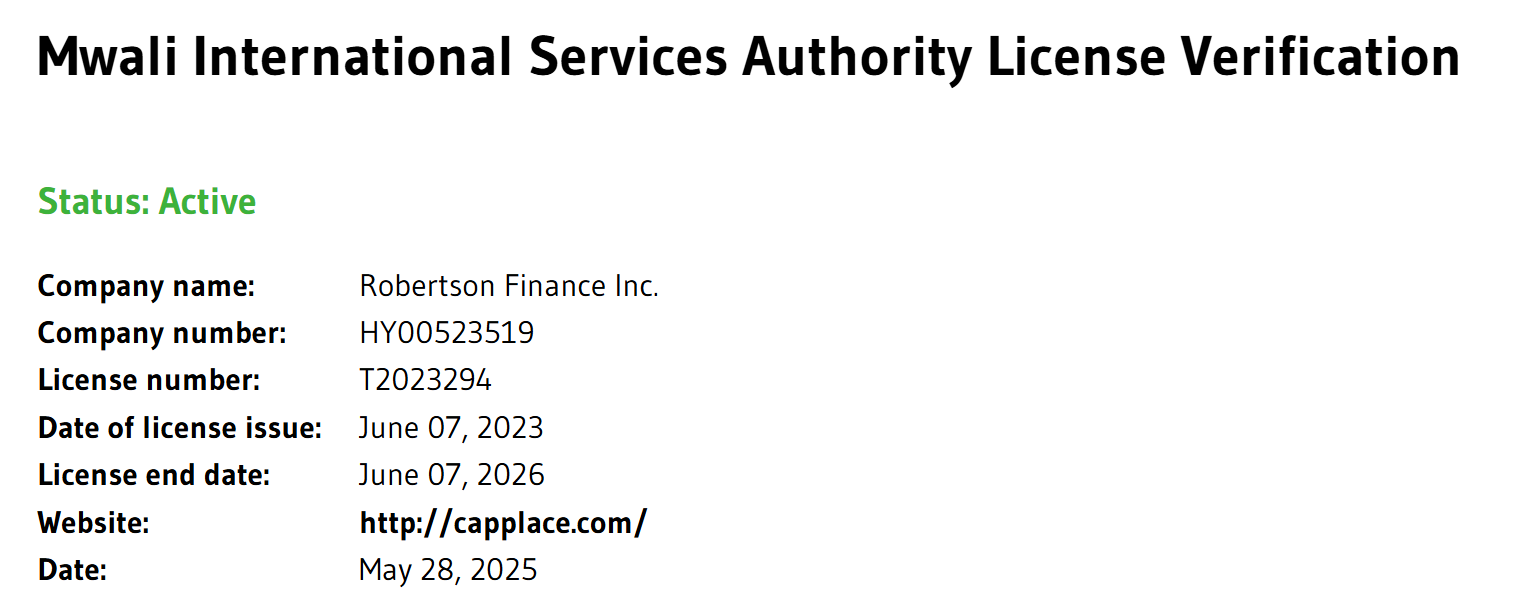
There is no doubt — the broker does hold a license. However, the question of trust remains unresolved. Most experts and reputable regulators do not recognize MISA licenses. The reason is straightforward: the regulator imposes virtually no restrictions on brokerage/dealer activities, does not enforce penalties in cases of justified client complaints, and effectively does not protect client rights or interests.
In fact, the main financial regulator of the Union of the Comoros, Banque Centrale des Comores (BCC), has repeatedly stated that regulators of the autonomous islands are essentially commercial entities that have independently assumed the authority to issue licenses, which are legally insignificant.
This explains the surge in registrations in the Union of the Comoros between 2023 and 2025, with the majority concentrated in Mwali (Moheli). At the same time, statistics show that no more than 20% of companies licensed in 2023 remain active, and no more than 40% of those licensed in 2024 continue operations. In our view, this clearly demonstrates the quality of such licenses.
Thus, CapPlace formally holds a license to provide brokerage services. However, in our opinion, neither this document nor the company operating under it inspires trust.
Company History
According to official documents, Robertson Finance Inc. and the CapPlace broker were established and began operations in 2023. Let us check whether this information is supported by the domain registration data.

According to the Whois service, the domain capplace.com was originally registered back in 2006. However, the company acquired it only in 2023 (prior to that, it had been listed for sale by the registrar for more than four years). Meanwhile, based on snapshots from the Web Archive, actual activity on the site can only be traced starting from May 2025.
This suggests that from the very beginning of its operations, the broker has deliberately kept website visitors and clients on a limited information diet. This does not reflect positively on the company.
CapPlace Online Reputation
The broker has been operating online for nearly two years and could have accumulated a substantial number of reviews during this time. At one point, when the platform first caught our attention, we observed more than 200 comments about it on Trustpilot.
However, the current picture is very different: the platform now shows only 38 reviews, of which 89% are negative. Moreover, the page header warns that the company’s rating is not calculated due to violations of the platform’s rules. This suggests that fake positive reviews were identified and removed.
The overall online reputation is far from consistent. On some websites, authors claim they have never seen a better broker. However, specialized platforms tend to provide the opposite assessment. For example, on WikiFX, the platform has a score of only 1.32 out of 10, and users are warned about the absence of a valid regulator (the MISA license is not recognized there either).
Pros and Cons
-
Low entry threshold — a $250 initial deposit is affordable for most traders.
-
The broker is officially registered and operates under a license, although it is rarely recognized.
-
The official website provides very limited information.
-
Most non-trading operations are conducted in cryptocurrencies, which, in our view, contradicts AML policies.
-
Trading conditions are hardly favorable, and the risk level for retail traders is extremely high.
-
Only negative reviews about the platform remain online.
Final Take
Based on the results of our analysis, we can confidently classify CapPlace as a scam project. While the company does operate under a license — albeit an offshore one — its approach to the official website, non-trading operations, and information disclosure raises serious concerns. At the same time, previously published positive reviews appear to have been removed, leaving only negative feedback from both former and current clients. Therefore, we see no grounds to trust this company.


I was deceived twice. First, they deducted an “insurance fee” from my account that was never mentioned anywhere. Then the platform started freezing, and I began to question the fairness of trading with CapPlace. I decided to withdraw at least my remaining $5,000. I submitted a request, went through verification for several days, and then the request remained pending for almost a week. Eventually, I received an email stating that I could not withdraw this amount without paying taxes. I argued with support for almost a month, and one day my account balance suddenly became zero. They told me it was due to account inactivity. These are scammers who will never return my money.
CapPlace are scammers! I deposited $5,000 because they had registration, a license, and the conditions seemed good to me. Then the terminal froze, and all my trades went into losses. I got nervous and went back to read reviews again. Strangely, within just a few days, there were more reviews – more negative ones, though some positive ones too. I don’t know what to do now. There is no money left in my account, and even lawyers are unlikely to help. After all, I made the deposit myself and traded on my own.