Our kaeser-llc.com review provides information about yet another Forex/CFD scam broker. The company traditionally advertises its services heavily, emphasizing a wide selection of trading instruments, a wealth of educational materials, and a state-of-the-art trading platform. We’ve seen such offers many times, and we know for sure that traders will receive nothing of the sort with this project. All they can expect is a complete loss of their investment. To substantiate our claims, we’ve provided arguments below to support our position.
Quick Overview
Domain: https://kaeser-llc.com/
Company Name: Kaeser LLC
Year Founded: 2025
Jurisdiction: Unconfirmed
Legal Status: No license
Minimum Deposit: 500 USD
Leverage: Unknown
Available Assets: Forex & CFDs
Trading Platforms: Webtrader
Account Types: Basic, Smart Start, Full Package, VIP
Deposit/Withdrawal Methods: Crypto
How to Register on the Website
Honestly, the official Kaeser LLC website left us with mixed feelings. On the one hand, it’s quite attractively designed (if you don’t count the rather poor choice of font sizes and colors in text fragments) and the pages are well optimized for loading. However, perhaps the developers were just filling out a ready-made template. On the other hand, the uninformative and practically useless content is striking. Perhaps there’s more information in the personal account.
It all started out quite well. At least, creating an account definitely takes just a few seconds, as you only need to fill out a few fields:
- First and last name.
- Email address.
- Password (twice).
- Country of residence.
- Phone number.
However, even here, the broker violates the requirements of almost every regulator: the user is not offered a single document to review and sign.
Things get even worse:
- New clients receive an account immediately after submitting a completed form, without any additional verification.
- No other personal information (even your address) is collected in the workspace.
- No questionnaires or testing are conducted.
- You can top up your account and start trading without verification.
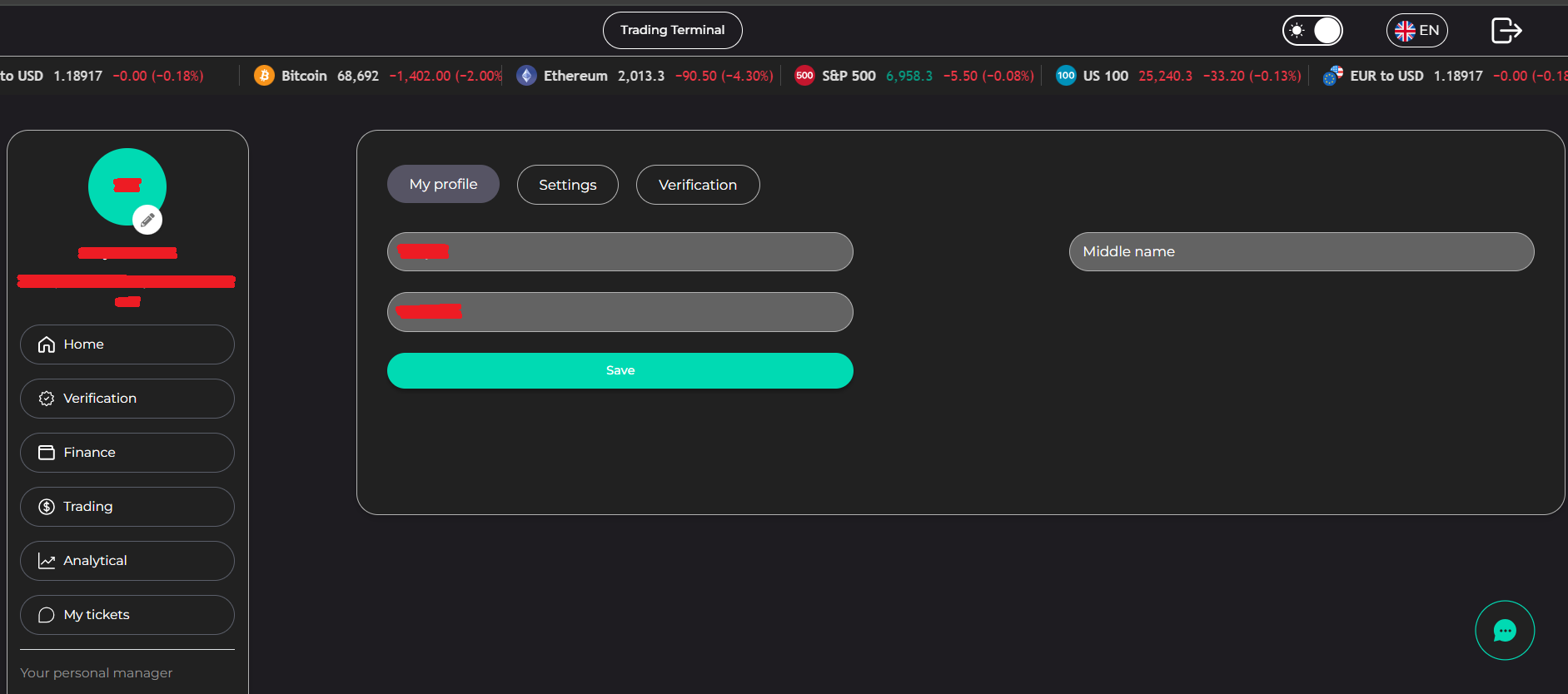
We got the impression that the company serves not traders from Europe (which one might expect, judging by the registration data provided), but penguins in Antarctica. This conclusion is prompted by a complete and, most likely, demonstrative disregard for all accepted industry standards.
Meanwhile, the broker requires verification, which immediately leads to awkward questions:
- Why should they? They don’t have KYC or AML (surely a few words in the Terms & Conditions don’t count as such).
- What are they going to verify if their only knowledge of the client is their full name and contact information?
- How does the company plan to manage copies of documents in the future?
There are other questions, too. For example, the account types page mentions bonuses for clients. Where are they in the personal account? How do we get them, and can we refuse them? Where can we check the status of my current bonus? Most likely, no one at Kaeser LLC expected these questions, as the broker has no intention of fulfilling such promises.

Kaeser LLC Trading Instruments and Platforms
One thing the broker’s website developers have certainly excelled at is giving it a solid appearance. For example, on the main page, visitors are impressed by the list of available markets for trading, which includes retail Forex currency pairs and CFDs, with the following underlying assets:
- Stocks.
- Bonds.
- Commodities and raw materials.
- Cryptocurrencies.
- Major indices.
- ETFs (Exchange Traded Funds).
- Futures and options.
This looks good, especially considering that not every regulated Forex/CFD broker can offer their clients such a wide selection of assets. It could have been even better if visitors were limited to the homepage.
However, unfortunately for the project’s owners, many users carefully read everything presented to them on the website. And the company’s employees were so inattentive that they actually refuted the information posted on the Homepage on the Trading Instruments page.
Yes, there’s a list of available markets here too. But it’s much more limited than the one mentioned above. For some reason, it only contains five asset groups: stocks, indices, ETFs, cryptocurrencies, and Forex pairs. Which should we trust? To answer this question, we decided to take a look at the trading terminal. Here, in the selection of markets, we found a third list: shorter than the first (it still lacks bonds and futures/options), but longer than the second, due to the addition of commodities. This raises a logical question: did the company’s content staff fail to check the asset list on the trading platform? Or are they so disregardful of traders’ needs and interests that they didn’t even consider it? In any case, this approach is hardly productive, and it’s hard to believe that it’s used by a legitimate company. It’s more typical of scam projects, and that’s precisely what we consider Kaeser LLC to be.
Incidentally, the broker’s trading terminal is far from the best example of such specialized software. Like most web platforms used by numerous third-tier platforms and scammers, it’s based on the free price chart widget from TradingView. As a result, users have an impressive array of graphical objects at their disposal. However, the list of indicators is not as extensive as we’re used to, and this artificial limitation significantly limits market analysis capabilities. The implemented one-click trading feature deserves a positive review.
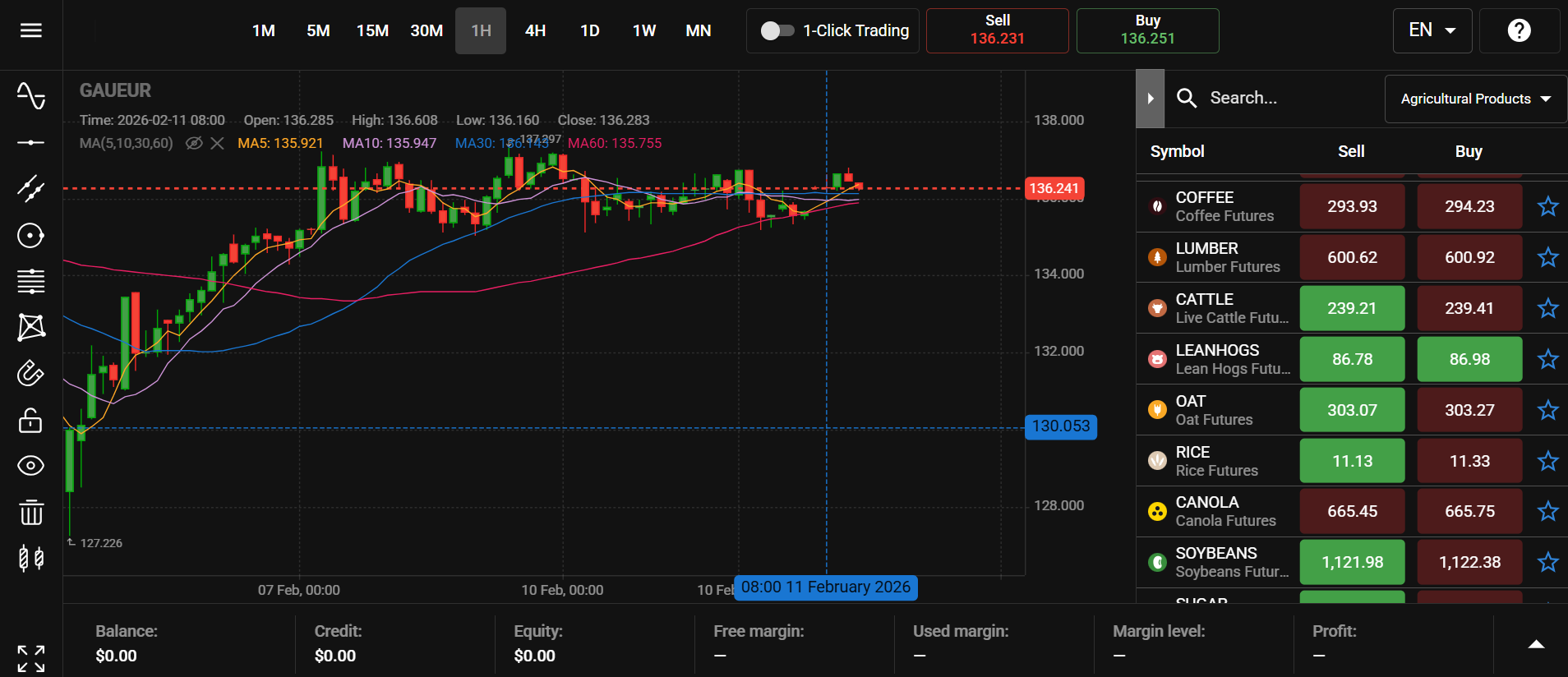
Perhaps that’s where the program’s advantages end. However, it has many more disadvantages:
- The price chart window in the workspace is the only one (the terminal doesn’t support multi-chart mode). This hinders the efficiency of traders managing asset portfolios.
- The market overview doesn’t even include contract specifications for each trading instrument. Quickly selecting a ticker to display in the chart window is also problematic: users must either first find the desired asset group or scroll through the entire list. The quick search system and adding to favorites only partially solve this problem.
- Chart settings and the terminal itself are not saved; they must be restored manually at the start of each session.
- The connection quality to the server leaves much to be desired; the connection is lost on average every 10 minutes, even if the terminal window remains active.
- We were unable to find any automated trading features, although Kaeser LLC assures potential clients in the account descriptions that they are available. There is no option to add a trading robot or an API description in the terminal (nor is there any platform documentation).
Account Types Offered
Kaeser LLC also has a very poor record when it comes to publishing trading conditions. Neither the homepage nor the Trading Instruments page provide a complete list of available assets or contract specifications. Now let’s take a look at the account type descriptions.

We have 4 tariff names before us:
- Basic.
- Smart Start.
- Full Package.
- VIP.
The broker doesn’t disclose any actual trading conditions in this table. Dear traders, didn’t you find the information there very helpful? You were likely particularly inspired by the information that you can only participate in webinars or receive a personalized investment plan with the two higher-tier plans. How much will this cost you? We can’t answer that question precisely.
Frankly, the project owners’ approach is somewhat surprising. Do they really think any sane person would open an account based on such meager information and bring in hundreds or thousands of dollars? However, if you invite clients by phone and don’t show them this inadequate website, then anything is possible.
Incidentally, we were wrong. The website also provides information about trading conditions on the Fees and Commissions page. Here, the broker states that all client costs are reduced to commissions, making the calculation of fees for each trade as transparent as possible. Moreover, the platform’s commission for any action — buying or selling an asset, rolling over a position, or receiving passive income — is “only” 1.5%.
To understand just how “only” that is, let’s give a simple example. You enter into a trade using the entire minimum deposit amount ($500). With leverage of 1:10, you have access to a volume of $5,000, or 0.05 standard lots. The commission, calculated based on the trade amount, is 1.5% of $5,000, or $75. In other words, 15% of your deposit will go to the platform. A trade of 0.05 standard lots earns you 0.50 cents per pip of price change. To cover the broker’s commission, you would need to earn 150 pips. Let’s be clear, this is practically impossible to achieve within a trading day. But holding a position for several days isn’t an option, as you’ll pay the same amount every day in rollover fees. Incidentally, 1.5% per day for rollover is the fee for using the broker’s credit, amounting to almost 550% per annum.
And that’s not all. In addition to the platform fee, you’ll also pay an account-based fee. For the Basic account, this is another 1.5%, and for the Full Package, 0.5%. So, the profit required to cover the fees increases even more.
Do you think you’ll be able to make any money with such a high brokerage? We doubt it. Some might argue that with higher leverage, things don’t seem so bad. Indeed, at 1:100, you’ll only need 15 pips of profit to cover the commission in the previous example, while at 1:1000, only 1.5 pips. While the first of these values could also be a problem for a trader, the second seems quite acceptable. However, keep in mind that the risks and losses will increase exponentially if you choose the wrong entry point. Most likely, with a leverage of 1:1000, you won’t have to pay any commission at all on the second or third trade, since your deposit will be exhausted.

We didn’t discuss the three leverage levels in vain — the broker didn’t bother to disclose this crucial metric. Without it, as you’ve already seen from the example, it’s difficult to assess profit potential, risks, and, of course, the company’s insatiable appetite. Why isn’t it published? Perhaps the platform’s owners didn’t want to scare off potential clients. Indeed, such actions are not uncommon for scammers.
Deposits and Withdrawals
In its FAQ, Kaeser LLC promises clients the most convenient and secure methods for depositing funds. These include bank transfers, credit/debit cards, and wallets in certain e-payment systems. In addition to these, the Terms & Conditions also include cryptocurrency transactions. It’s worth noting that the personal account even includes bank card verification, which requires a photo of both sides with the details partially obscured.
This last point deserves special attention. In the same personal account, deposits are only possible in cryptocurrency via direct transfer or through the Crypto Payer intermediary. So what does the user’s card have to do with this? And of course, it becomes clear why the broker doesn’t have AML measures. What kind of anti-money laundering measures can we talk about when both the recipient and sender of the payment are anonymous?
Kaeser LLC Legal Status: Legitimate or Not?
So, we see that the company was eager to create the illusion of a legitimate and fully regulated broker. This was likely intended to either attract new clients or strengthen the trust of existing ones. However, we have to disappoint its owners: even the first impression reveals that this is a scam project, and they have failed to create a convincing narrative. Entrusting such important tasks to amateurs is a mistake, leading to ruin. Moreover, this applies both to working with business registries and to official information published on the website.
We’ll discuss the latter in more detail. The company posted its Swiss address and phone number on the website, and its Terms & Conditions listed the company’s registration information from the Swiss business register. Newcomers may believe this, but we have thoroughly verified this information.
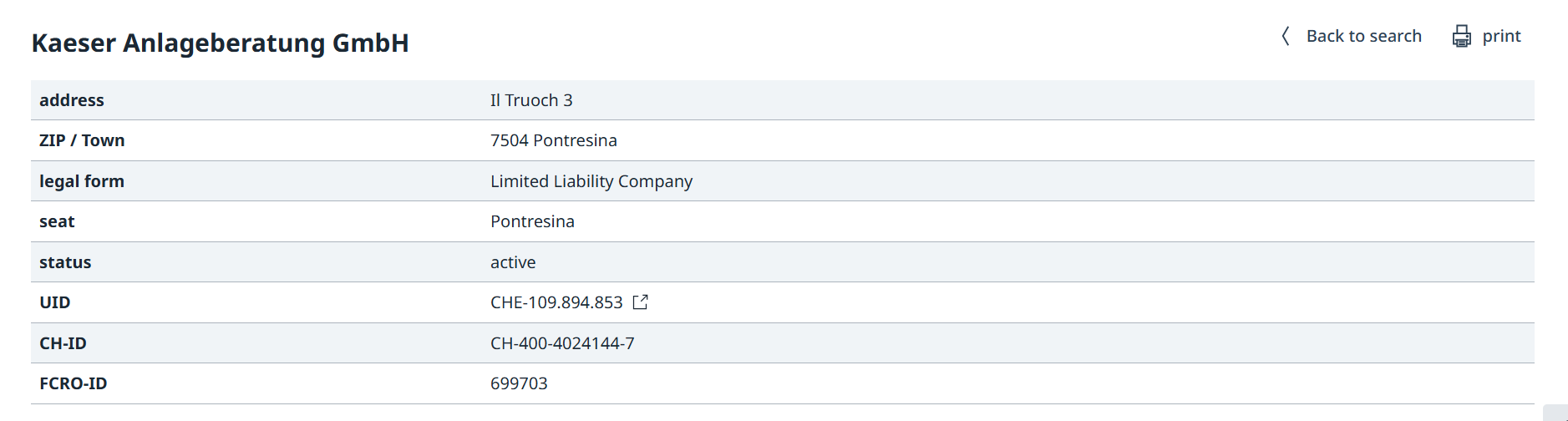
The Swiss registry does indeed contain a company entry with the listed broker, UID CHE-109.894.853. Even the address in Pontresina matches. However, this doesn’t necessarily mean the platform owners can be trusted.
Firstly, the full name of the company, Kaeser Anlageberatung GmbH, doesn’t match Kaeser LLC, the broker’s self-proclaimed name. Even ignoring the final letters denoting the legal form (LLC and GmbH are practically the same, but in different languages), the version published on the website is missing one word. Incidentally, this word is truly important, as it reflects the company’s scope of activity — investment consulting.
Is it worth checking for a license from the Swiss regulator FINMA, after all? We were sure it wouldn’t make sense, but we did a search for the name of a real Swiss company, since, as you’ve already figured out, the fictitious Kaeser LLC simply doesn’t exist.
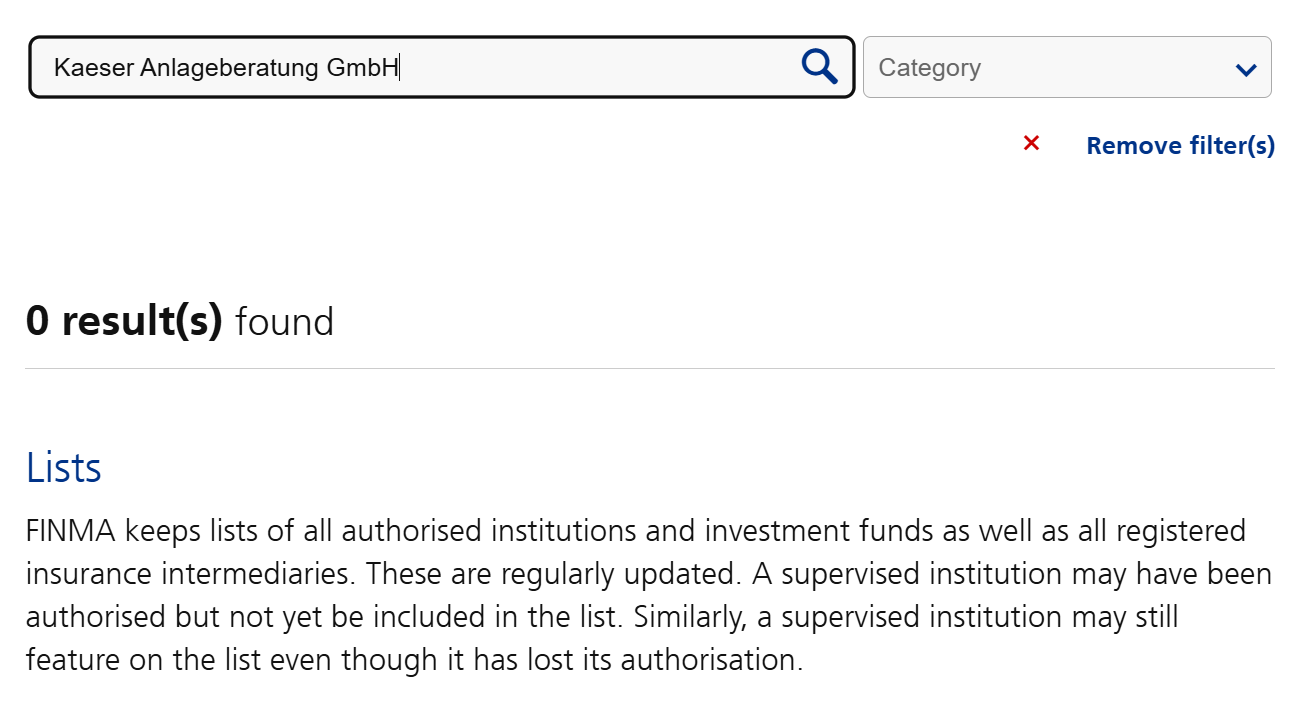
The result was entirely predictable: Kaeser Anlageberatung GmbH operates without an FINMA license, as its activities do not require licensing or regulation. At the same time, brokerage/dealer services are provided only with a local license. Even passporting documents from EU regulators is not available in Switzerland, as the country is not a member of the EU or EEA.
Just a couple of minor facts remain to be added. First, on December 11, 2025, BaFIN (Germany’s financial regulator) issued a warning that Kaeser LLC was a scam. Second, on February 2, 2026, Switzerland’s FINMA added the broker to its warning list, announcing that it had no connection to a legitimate Swiss company.
Company History
In fact, our Kaeser LLC review could easily have ended with the previous section. As we discovered, the broker doesn’t actually exist, uses someone else’s registration information, and is represented solely by an online website. However, we were curious to know how long the scammers have been working with clients.
There’s no way to determine this from the website — the company doesn’t publish any information about its history, and trusting it even if it did would be foolish, to say the least. Using the real company’s existence (registered in 2020) to estimate its length is also incorrect — it has no connection to this scam. We can only rely on information that is definitely related to this pseudo-broker. This includes, in particular, the domain registration date, which can be easily obtained from publicly available WHOIS data.
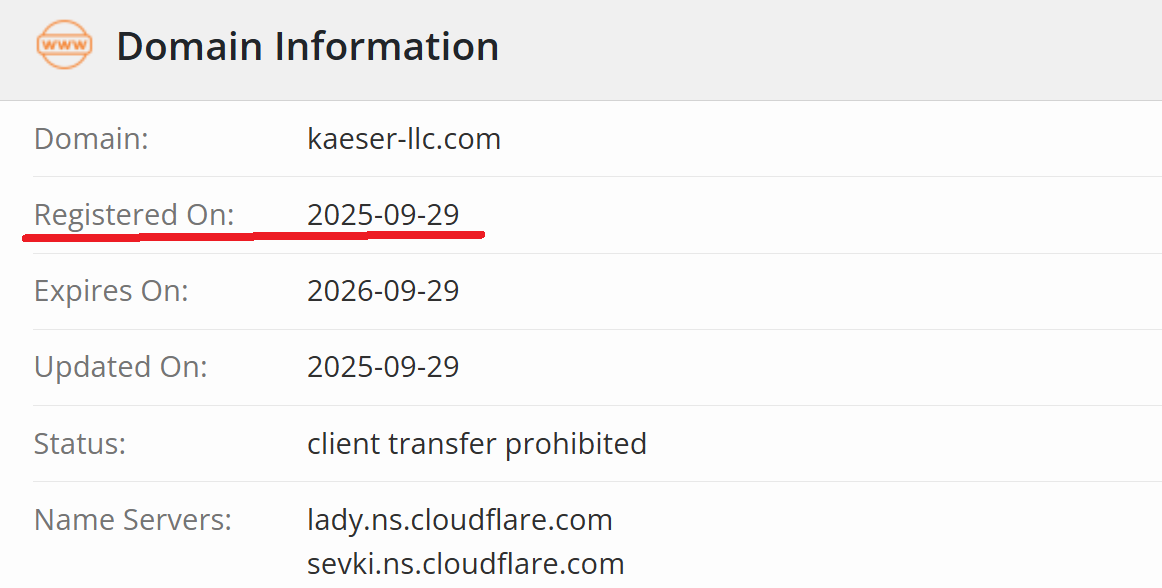
However, this timeframe is clearly insufficient to make the Our Achievements figures, which the platform’s representatives display on the About page, appear even remotely credible. We’re talking about 64,000 client accounts, which conduct daily trades totaling over $2.5 billion. To achieve this figure, Kaeser LLC would have to register approximately 450 accounts daily, and each registered user would have to execute a trade of $30,000 per day. For a website, personal account, and trading service, this is simply ridiculous.
Kaeser-llc.com Online Reputation
Almost five months of existence is enough time for reviews about the broker to appear online. However, as experience has shown, not a single reputable portal (such as Trustpilot or Sitejabber) mentions this fake company. However, we found several publications that the company used to build a positive reputation. They were posted on social media. The campaign was also supported by some information sites. Their enthusiasm is easily explained — the positive reviews were apparently quite well-paid.
Nevertheless, there are also more objective sources online, such as specialized investment and trading portals. On these sites, the fake broker didn’t even reach a neutral rating, and on some, such as Personal Reviews, it was rightly called a scam.
Pros and Cons
-
There's a German version of the website.
-
Almost complete ambiguity regarding trading conditions.
-
Use of cryptocurrency for money transfers.
-
Attempt to pass the project off as a third-party legal entity.
-
A complete lack of regulation.
-
Warnings from reputable regulators regarding fraudulent activity on kaeser-llc.com.
The Final Take
In our Kaeser LLC review, we’ve fully addressed the issue: demonstrating that this broker is a no-no. The company operates illegally, as it’s neither registered nor licensed, and even uses the name of an existing Swiss company. Reputable regulators, such as BaFIN (Germany) and FINMA (Switzerland), have warned that the project is a scam. Traders have discovered that its owners conceal all vital information, from trading conditions to regulatory details. Avoid dealing with this pseudo-company.


This broker is a complete scam. The image is beautiful, the promises are even better, but when it comes to withdrawing funds, well… Waits, thousands of excuses about all sorts of obstacles, and that’s it—no withdrawal. You can simply forget about any amount you send here!
Scam!! Those scoundrels from Kaeser LLC do whatever they want with inexperienced clients. If you manage to earn even a little money with this broker, they’ll require you to go through 10 verification steps when you withdraw your profits, and then block you for excessive activity. Scammers!!